Uthwaite
Lady Chatterley's LoverUthwaite is an old market town in the dales and a regional center whose streets hold together two different landscapes: the older world of crooked roads, historic houses, and local status, and the expanding industrial world of mines, railways, foundries, and workers’ housing. For Connie Chatterley, journeys through the town and its surroundings make that transformation visible, while the town’s connection to the Chatterley name shows how the family’s inherited authority remains present amid change.
Setting and Historical Layers
Uthwaite lies in a valley threaded by railways leading toward Sheffield. Its older identity as a market town is still legible in the crooked streets behind the church and in the Chatterley Arms, one of its principal inns. The town is also a place from which the surrounding dales were once reached: roads led outward toward castles and large country houses, reminders of a landscape in which landed families dominated the view.
That older order has not simply disappeared. From the uplands, Chadwick Hall appears as a great Elizabethan house set apart in its park, but its grandeur belongs to a past that has been overtaken. Uthwaite itself preserves older buildings and streets, yet its valley is increasingly occupied by industrial structures. The resulting landscape is neither wholly ancient nor wholly new: the historic town remains, but it is enclosed and unsettled by the scale of modern production.
Industry and the Changing Valley
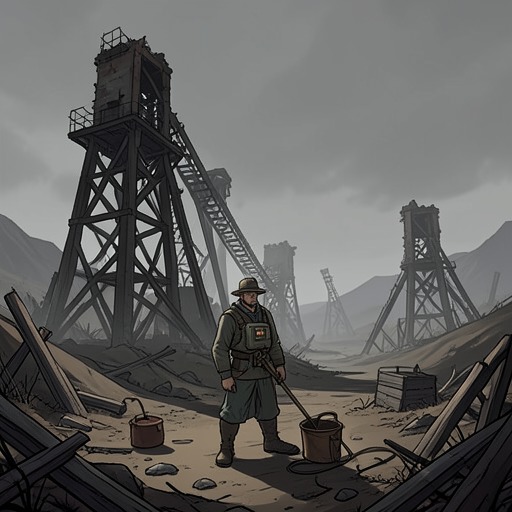
The industrial presence is not confined to the town’s outskirts. Coal mines and steelworks send up smoke and glare, while rail lines, foundries, and large works occupy the lower ground. From the streets, the scale of these installations can reduce the surrounding view to walls and industrial structures; heavy lorries shake the ground, ironwork produces a deep clanging noise, and whistles cut across the town. A policeman must hold traffic while lorries carrying iron pass, delaying his greeting to Connie’s car. The episode makes industrial movement an active force in public space, not merely a distant feature of the view.
The built environment also records changes in the workforce and its housing. Old, blackened miners’ cottages line the roads out of town; beyond them stand newer, larger rows for more modern workers. Farther still, new mining settlements appear across the slopes and hollows, in some places breaking into the open countryside. Between these newer developments remain fragments of older rural England. The layers lie side by side, but the newer industrial settlements and infrastructure increasingly define the valley’s appearance.
This transformation forms the local background to the uncertain fortunes of the mines. Tevershall and New London are the two collieries discussed in the surrounding community: Tevershall, once a celebrated and profitable mine, is now in decline, while New London has struggled in poor economic conditions. Workers leave for newer operations at Stacks Gate and Whiteover, where chemical works and better housing offer different prospects. The account of Uthwaite’s industrial setting thus belongs to a wider regional shift in mining, labor, and investment, rather than to the fortunes of a single town alone.
Routes, Visits, and Local Associations
Uthwaite is a destination in the Chatterleys’ movements through the area. Mrs Bolton encourages Connie to go out and to drive there, countering her habit of remaining indoors. On another occasion Connie accompanies Clifford in a car, with a young chauffeur able to assist him in and out of the vehicle. Clifford especially wants to visit his godfather, Leslie Winter, whose home, Shipley Hall, is not far from Uthwaite. The journey connects the market town to the surrounding estates and to the local relationships that still shape the Chatterleys’ position.
The town also supplies a measure of that position. In Uthwaite, Wragby is known as Wragby, as though it were a place in its own right, rather than merely a house near Tevershall. The distinction matters: the family estate carries a public identity beyond its boundaries, and local recognition turns the Chatterleys’ residence into a regional reference point. Uthwaite therefore serves as more than a stop on the road; it is one of the places where the social geography of the estate becomes visible.
Narrative Significance
Connie’s passage through Uthwaite and the surrounding valley contrasts the country’s inherited landmarks with the physical consequences of industrial expansion. The old market streets and the great houses recall a past shaped by land and lineage; railways, works, mines, and successive rows of workers’ homes show a present reorganized around extraction and manufacture. The town’s setting gives this contrast a concrete form, including the way industrial traffic interrupts ordinary movement and the way new housing spreads into the valley.
The industrial environment also provides context for Clifford Chatterley’s renewed interest in mining. As he turns again to the pits, descends into the workings in a tub, studies technical reports, and explores the possibilities of coal and shale as sources of new fuels, the region’s industrial system becomes both an economic reality and an object of technical ambition. His research develops around mining and fuel production; the account does not make Uthwaite itself the site of those experiments, but the town and its valley establish the industrial world in which such plans matter. In this setting, Uthwaite marks the meeting point between the Chatterleys’ inherited local authority and a modern economy whose industries are reshaping the land and the lives organized around it.